
Fast Fashion Trends Transforming the Future of Apparel Retail
Shifting Consumer Preferences and Purchase Behaviour
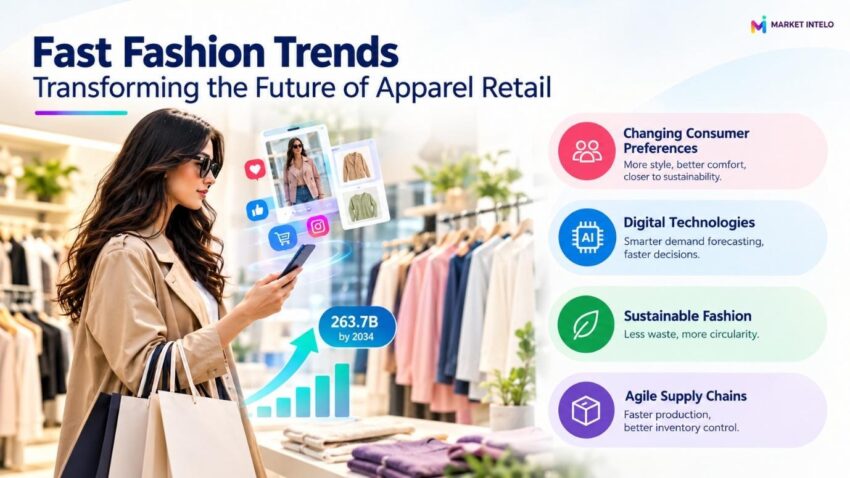
Fast fashion is evolving especially since consumers have begun to demand not only lower prices for clothing but also a more frequent change in designs and a convenient shopping opportunity. Historically clothing brands used to launch new collections based on seasonal cycles that occurred four times a year. Nowadays, many clothing brands release new styles every couple of weeks, decreasing the time between style’s appearance and being sold out.
Social media makes new styles popular quite rapidly, often in less than 72 hours, meaning that brands have to react quickly. Besides, customers begin to pay more attention to the longevity of clothes that they buy, the comfort they deliver, and ecological consequences of their production.
Digital Technologies Allow Retailers to Make Faster Decisions
Digital technology is enhancing the process of determining demand and executing new product development in the apparel industry. AI technologies study customer interactions, as well as their searches and purchase history, to help identify new patterns in demand for clothing. Various demand prediction software uses past sales data and present shopping habits of consumers.
For example, when there has been an increase of 15% in searches for oversized jackets during one week, the retailer might decide to check its orders. The automatic systems of inventory management guarantee a high degree of visibility of stock both in warehouses and in retail stores.
Read: How to Develop Your Own Signature Style as a Fashion Designer
Social Commerce Driving Shorter Trend Cycles
Social media are currently important means for exploring fashion trends, particularly for the young audience. A product appearing in a brief video may have hundreds of interactions in a few hours, implying that the demand for the product may exceed the retail supply. A fashion trend lasting 30 days requires a different approach to stock management in comparison to the one lasting for six months. Retailers check engagement rates and information on sales.
Advancement of economic online stores is greatly influenced by the development of various technologies. An estimate from Marketintelo shows that the market of fast fashion is projected to grow up to $133.4 billion by 2025. It may even reach $263.7 billion by 2034, which means the compound growth of 8.7%. Such growth in the sector signifies the necessity of proper inventory management, fast product development, and shift of distribution approaches.
The only positive side of social commerce is that users can move from finding the product to purchasing it. However, tracking audience engagement is not enough for achieving sales. With the help of impressions, clicks, and returns, retailers can analyze whether it is necessary to increase product output.
Supply Chain Agility Through Efficient Production
The production of fast fashion can only take place when the design, making, delivery, and selling departments work in coordination. Manufacturing can last from several days up to months, depending on the type of fabric, the present manufacturing capacity, and the distance. Digital planning, sourcing close to the market, and small production runs can address unexpected changes in demand.
This approach eliminates unused stock, despite the fact that small production runs may result in the growth of the production costs. Having seven days of delayed shipments can threaten sales of fashion-sensitive items. Efficient supply chains should be able to achieve the required level of balance between the quickness of production, cost, dependability, and responsible production.
The Impact of Sustainability on the Circular Fashion Industry
Fashion companies are being pressured by environmental issues to alter their production methods and product lifespans. According to some estimates, clothes account for about 2 to 8 percent of global greenhouse gases, depending on the measurement methods and definitions used.
However, there will always be textile waste since cheap clothing will continue to be discarded after wearing it just a few times. However, there are other ways to preserve the continuous cycle of fashion, including the second-hand market, repair shops, recycling technologies, and return programs.
- Recycled materials: The application of recycled fibers can relieve the burden on the supply of raw materials but results largely vary depending on the processing methods of materials and their nature.
- Fabric longevity: Increasing the number of uses of the item from 20 up to 40 allows reducing the environmental impact per use.
- Resale platforms: The use of pre-owned items reduces the need for newly produced apparel in case second-hand items replace new acquisitions.
- Tracking Waste: Tracking how many unsold goods are available is essential for merchants to learn the facts about overstock and improve their ordering process.
The observations have to be directed toward the results that can be achieved by means of performance criteria instead of sustainability claims. Successful recycling can be accomplished only when there is an appropriate infrastructure for the organization of collection, separation, and disposal of waste.
Applying Data-Driven Inventory Management to Achieve Optimal Pricing
Inventory accuracy is linked to profitability in that fashion trends may dictate which clothes are in vogue. Merchants can benefit from sale dashboards allowing for evaluation using different criteria (color, size, location, or prices).
For instance, in case a particular item is sold out at 300 pieces in week 1, it is safe to replenish it, while brands with similar top allocations but orders of merely 80 will have to apply other instruments, such as price adjustments.
| Retail strategy | Illustrative measurement | Business implication |
| Trend monitoring | 7 days of search activity | Identifies emerging demand |
| Small batch production | Initial run of 500 units | Limits inventory exposure |
| Replenishment planning | Review after 14 days | Supports informed ordering |
| Markdown management | Review after 30 days | Helps manage unsold stock |
| Returns analysis | 12% return rate | Highlights fit or quality issues |
The numbers are just illustrative examples rather than actual industry averages. Acceptable limits are different depending on garment category, price level, and suppliers’ lead time. The application of several indicators allows for more precise decision-making than mere reliance on sales volume.
The Future of Apparel Retail
The success of the fast fashion industry in the future hinges on its aptitude for integrating speedy operation with a solid level of discipline. Various innovations like artificial intelligence, social commerce, flexible manufacturing, and inventory monitoring enable companies to meet the demand in time. On the other hand, sustainability problems, textile waste, and transparency of supply chain put under question the practice of continuous production.
In the coming five years, companies that know how to merge demand estimations with small production runs and exact measures of sustainability will manage uncertainty better. Among the most critical tasks will continue to be the achievement of a balance between the company’s affordability, availability of products, and responsible resource usage. Fast fashion trends will still have a significant impact on clothing retail as businesses will have to adapt to short trend cycles and new customers’ expectations.